Title: Isolating Coupled Effects by Interface Editing of Intermetallic Heterostructures for Fuel Cells
Authors: Huang, Xuan; Sun, Haoran; Liang, Zhiyao; Zheng, Zhenying; Zhan, Changhong; Wei, Xian-Kui; Hu, Zhiwei; Liu, Wei; Shao, Qi; Huang, Xiaoqing
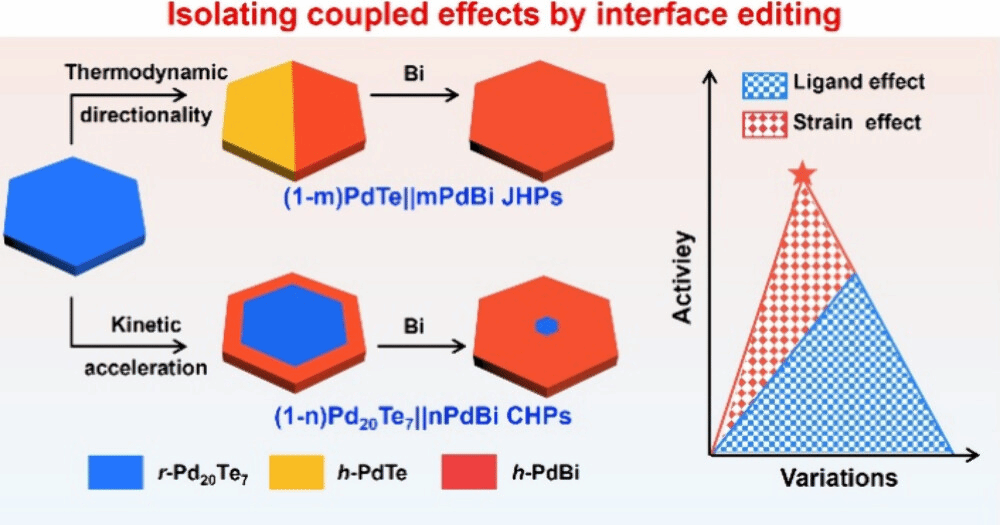
Abstract: Heterostructured nanomaterials have demonstrated extraordinary catalytic enhancements through engineered heterostructure-induced interactions, yet the origins remain largely elusive since current limitations in fabricating model systems can isolate various coupled effects. Here, we report an interdiffusion-controlled atomic replacement strategy to achieve programmable customization for two distinct intermetallic heterostructure (i-HS) systems. The (1-m)PdTe||mPdBi Janus hexagonal nanoplatelet [(1-m)PdTe||mPdBi JHPs] system maintains a highly coherent heterointerface through proper lattice matching, enabling isolated investigation for ligand effects; the (1-n)Pd20Te7||nPdBi core-crown hexagonal nanoplatelet [(1-n)Pd20Te7||nPdBi CHPs] system with severe lattice distortion establishes a complementary model to explore strain activity. Systematic oxygen reduction reaction analyses reveal the volcano-shaped activity trends in both systems, where (1-n)Pd20Te7||nPdBi CHPs at low bismuth (Bi) loading (31 at. %) with 4.1% interfacial lattice mismatching achieve the highest peak performance compared to (1-m)PdTe||mPdBi JHPs at high Bi loading (62 at. %), which demonstrates that the strain effect provides a superior complement to the ligand effect for optimizing the catalytic performance. Remarkably, in the anion exchange membrane fuel cells (AEMFCs), the best-performing 0.69Pd20Te7||0.31PdBi CHP-based membrane electrode assembly delivers a peak power density of 1.37 W cm–2 and specific power of 27.4 W mgPd–1, substantially outperforming all cutting-edge AEMFCs, as well as long-term durability with a negligible power density loss after 100 h. This study establishes a programmable synthesis platform for interface-precise i-HSs, being critical for heterostructure design systems toward catalysis and energy conversion technologies.
Full-Link: https://pubs.acs.org/doi/10.1021/jacs.6c03329
