Title: Ligand-Orchestrated Burst Nucleation Enables Ultrasmall Phase-Pure High-Entropy Nanoalloys with Active-Armor Interfaces
Authors: Ma, Rui; Zhai, Chongyuan; Zhou, Ru-Yu; Wang, Yao-Hui; Lü, Linzhe; Liu, Dehua; Zhao, Mengting; Yang, Hu; Li, Qingyu; Li, Zhuogen; Huang, Zheng; Lin, Haixin; Qin, Yangzhe; Hua, Yiwei; Liu, Xiaochun; Kuang, Qin; Xie, Zhaoxiong; Li, Jian-Feng
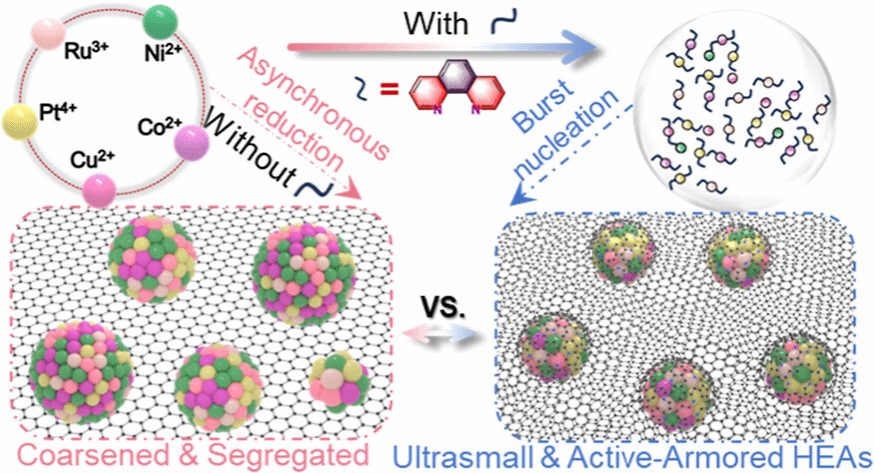
Abstract: High-entropy alloy (HEA) nanocatalysts offer exceptional compositional flexibility for electrocatalysis, yet their nanoscale synthesis is constrained by a thermodynamic–kinetic conflict: high temperatures required for entropic stabilization promote sintering, while asynchronous reduction of multicomponent precursors induces premature phase segregation. Here, we demonstrate a ligand-mediated strategy that addresses this conflict by employing 1,10-phenanthroline to coordinate disparate metal precursors. This interaction significantly retards the reduction onset, shifting nucleation into a narrow, high-temperature window where rapid atomic diffusion enables fast alloying. Simultaneously, the ligand’s in situ carbonization generates an atomically thin, chemically bonded N-doped carbon layer that kinetically confines nanoparticle growth and stabilizes the single-phase solid-solution phase against surface-energy-driven sintering. Distinct from physical barriers that passively isolate, the chemically coupled HEA–carbon interface functions as an active armor that enhances catalytic functionality by electronically modulating the HEA core and reshaping the local reaction microenvironment through regulated interfacial solvent organization and reactant accessibility. As a result, phase-pure ∼2.7 nm PtRuCuCoNi nanoparticles exhibit high oxygen reduction activity and durability, delivering a peak power density of 1.92 W cm–2 and maintaining stable operation for 100 h at a high current density of 1 A cm–2 in an anion-exchange membrane fuel cell. This work illustrates how integrating reduction retardation with chemically active encapsulation can transform stability constraints into functional advantages, offering a general strategy for resilient multicomponent nanomaterials.
Full-Link: https://pubs.acs.org/doi/10.1021/jacs.6c05904
