Title: Synergistically Competitive Coordination for Modulating Electrolyte Solvation Structures Toward High‐Performance Low‐Temperature Sodium Metal Batteries
Authors: Liu, Miao; Lin, Jiali; Lin, Jiande; Mao, Yuxiang; Wang, Fan; Wang, Huiqun; Zhang, Anke; Hu, Tao; Chen, Xing; Ji, Haoqing; Zhang, Jiaming; Zhang, Qiaobao; Zhang, Li
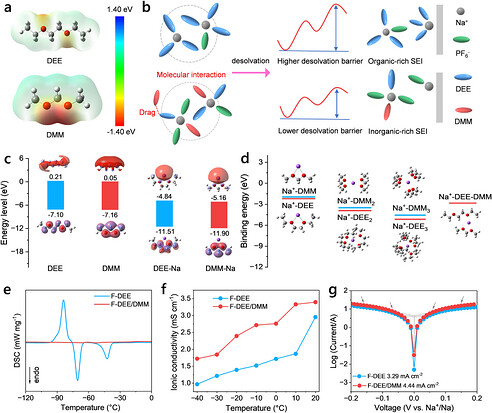
Abstract: With low melting points and viscosities, linear ether‐based solvents effectively lower the Na + desolvation energy barrier in low‐temperature sodium metal batteries. Among them, 1,2‐diethoxyethane (DEE) is considered a promising solvent due to its relatively weak solvating ability at low temperatures; however, its two oxygen atoms remain electronically isolated, forming quasi‐chelating bidentate coordination structures with Na + and still triggering a high desolvation energy barrier under extremely cold conditions. Herein, a novel electrolyte based on the concept of synergistic‐competitive coordination is designed by introducing dimethoxymethane (DMM) as a cosolvent into the DEE‐based electrolyte, where the lone‐pair electrons on oxygen atoms in DMM are partially delocalized, thus reducing its electron‐donating capability toward Na + and reconstructing the Na + solvation structure. Molecular dynamics simulations reveal that DMM competes with DEE for Na + coordination sites, thereby weakening the Na + ‐DEE interaction, lowering the desolvation energy barrier, and promoting anion‐involved coordination under severe cold conditions. Consequently, Na||Na symmetric cells run stably for over 3500 h at −40°C, while Na||Cu cells show 99.7% coulombic efficiency over 200 cycles at −20°C. Moreover, NaFe 1/3 Ni 1/3 Mn 1/3 O 2 ||Na full cell retains 78.7% capacity after 200 cycles at −20°C, while Na 3 V 2 (PO 4 ) 3 ||Na full cell maintains an impressive 99.2% reversible capacity over 300 cycles at −40°C.
Full-Link: https://advanced.onlinelibrary.wiley.com/doi/10.1002/adma.73375
