Title: Entropy-Driven Assembly of Low-Density Superlattices via Shape Camouflage
Authors: Sun, Zhiwei; Ding, Tongtong; Liu, Jincheng; Tan, Rongqing; Zheng, Zhiping; Shi, Yuqiang; Shen, Cong; Xiahou, Yujiao; He, Hongpeng; Xie, Zhaoxiong; Lin, Haixin
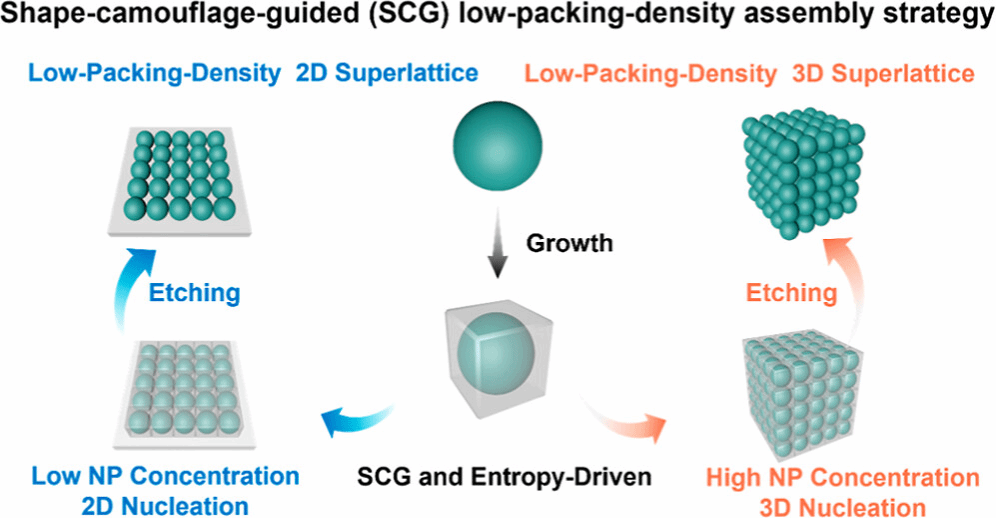
Abstract: Entropy-driven colloidal assembly exploits both shape entropy and depletion entropy to form ordered superlattices (SLs). In many colloidal systems, these entropic contributions tend to favor compact, high-coordination arrangements, making the fabrication of open, low-density SLs a notable challenge. We address this challenge using a shape-camouflage-guided (SCG) strategy. By epitaxially growing sacrificial shells on nanoparticles, we decouple lattice symmetry from core morphology, allowing the shell-defined effective geometry to direct assembly and translate it into target nondense architectures after shell removal. Crucially, selective etching of the shells leaves behind self-supporting 3D frameworks stabilized by direct interparticle contacts, avoiding the collapse common in traditional template-assisted methods. We demonstrate a programmable evolution from face-centered cubic to simple cubic lattices, applying this strategy to spherical and highly anisotropic particles across 2D and 3D dimensions. Furthermore, FDTD simulations reveal that these open frameworks generate intense electromagnetic hotspots. Consequently, this strategy provides a general route for fabricating programmable, high-porosity SLs, offering versatile platforms for advanced plasmonic sensing and near-field catalysis.
Full-Link: https://pubs.acs.org/doi/10.1021/jacs.6c04705
