Title: Correlating Interfacial Li + Exchange Rate with Reversible Cycling of Lithium Metal Anodes
Authors: Tao, Mingming; Lin, Hongxin; Wu, Wenhao; Zhong, Cong; Zhou, Yingao; Deng, Yuxi; Huang, Weilin; Shan, Peizhao; Chen, Junning; Zhong, Haoyue; Zhao, Danhui; Chen, Yanxin; Jin, Yanting; Wang, Xuefeng; Fu, Riqiang; Yang, Yong
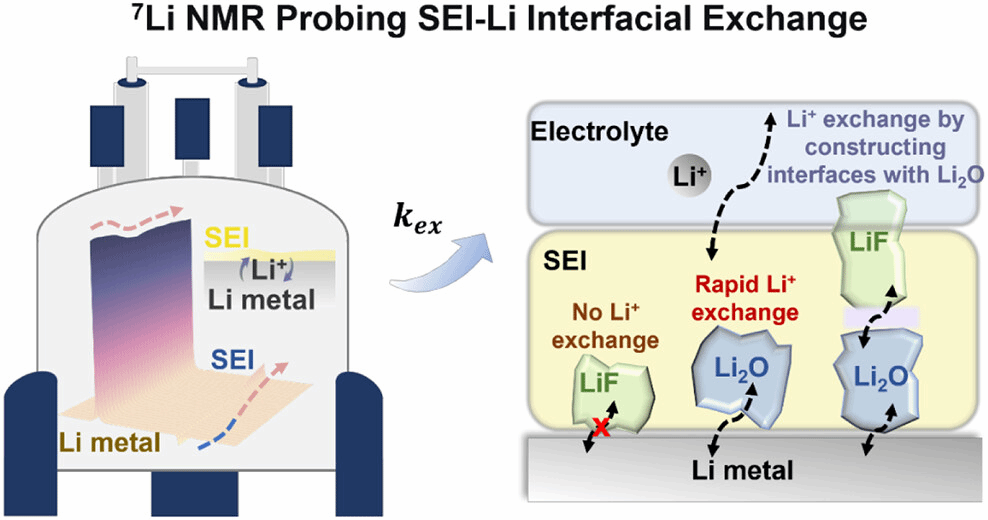
Abstract: The heterogeneous interface region serves as a critical domain in lithium metal batteries, where electrons, ions, and chemical reactions interact, significantly affecting cycling reversibility. However, the ion transport mechanism of the solid electrolyte interphase (SEI) still lacks quantitative characterization. Using Li metal mixed inorganic compounds as a model system, we correlate and quantify the Li + exchange rates of key SEI inorganic components by applying the saturation-recovery method and establishing a two-site chemical exchange model. We not only quantitatively reveal the interfacial ion exchange rate between lithium metal and its SEI via a selective nuclear magnetic resonance exchange spectroscopy (EXSY NMR) technique but also demonstrate a close connection between interfacial transport and lithium deposition morphology by a COMSOL simulation. Furthermore, through multiscale characterization including cross-polarization (CP) NMR and cryoelectron microscopy (cryo-EM), we elucidate the Li + transport mechanisms within the actual SEI: Li 2 O can facilitate rapid Li + transport, whereas the Li + transport of LiF is highly dependent on building an interface with Li 2 O. On the basis of these new kinetic insights, we construct a Li 2 S artificial SEI using atomic layer deposition (ALD), successfully achieving 99.5% Coulombic efficiency and promoting uniform and dense lithium deposition. Our findings provide valuable design principles for engineering efficient SEIs in future lithium metal batteries.
Full-Link: https://pubs.acs.org/doi/10.1021/jacs.6c06376
