Title: Phase Engineering of Pd–Te Hexagonal Nanoplates for Enhancing Nitrogen Oxidation
Authors: Wang, Pinlin; Xue, Fei; Ye, Xubin; Sun, Qipei; Huang, Xuan; Chan, Tingshan; Huang, Yucheng; Hu, Zhiwei; Chen, Nanjun; Huang, Xiaoqing
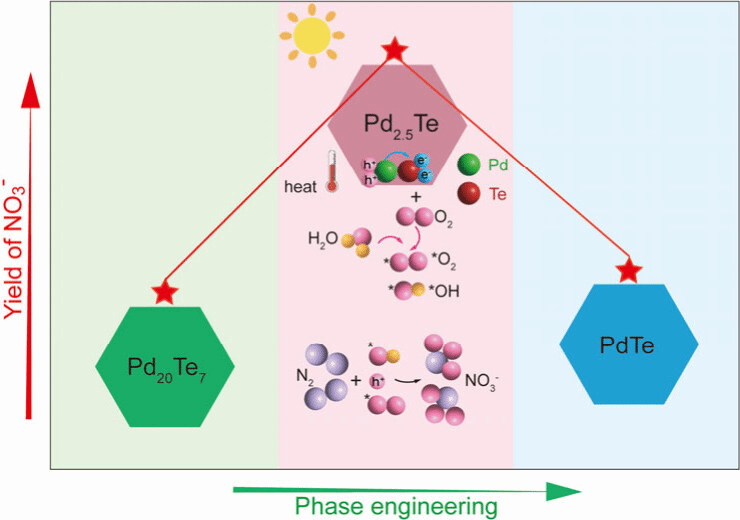
Abstract: Photocatalytic upgrading of nitrogen (N 2 ) to value-added chemicals, especially nitrate (NO 3 – ) products, is a promising alternative to traditional energy-intensive processes such as ammonia synthesis and ammonia oxidation. Although various strategies have been developed to enhance this reaction, the crystal phase dependence effect in the N 2 oxidation system has still not been explored. In this work, we chose the Pd–Te hexagonal nanoplates with distinct crystalline phases as the research subject and for the first time demonstrated the phase-dependent performance toward solar-driven N 2 oxidation to NO 3 – . Phase tuning of Pd–Te overcomes N 2 -to-NO 3 – conversion bottlenecks, with Pd 2.5 Te as the most effective catalyst. Under full-spectrum irradiation, the NO 3 – production rate of Pd 2.5 Te reaches 372.2 μmol g –1 h –1 at room temperature under atmospheric pressure without a sacrificial agent, which is around 4.4 and 6.2 times that of Pd 20 Te 7 and PdTe, respectively. In situ X-ray photoelectron spectroscopy (XPS), in situ electron paramagnetic resonance (EPR), and in situ attenuated total reflection Fourier transform infrared (ATR-FTIR) spectroscopy show that holes and electrons are generated on the nanoplate surface under photoexcitation, which react with oxygen (O 2 ) to convert it into hydroxyl radicals (·OH) and superoxide radicals (·O 2 ), by which N 2 is activated and oxidized to generate NO 3 – . This work highlights the importance of phase engineering for boosting N 2 conversion into NO 3 – .
Full-Link: https://pubs.acs.org/doi/10.1021/jacs.6c04881
