Title: Tracing the Origin of Driving Force of Photoinduced Interfacial Electron Transfer Reaction by Colocated Scanning Electrochemical Microscopy
Authors: Nan, Wenjing; Liu, Xuan; Lin, Jiayang; Wang, Yang; Han, Lianhuan; Hu, Ren; Su, Jian-Jia; Oleinick, Alexander; Svir, Irina; Amatore, Christian; Tian, Zhong-Qun; Zhan, Dongping
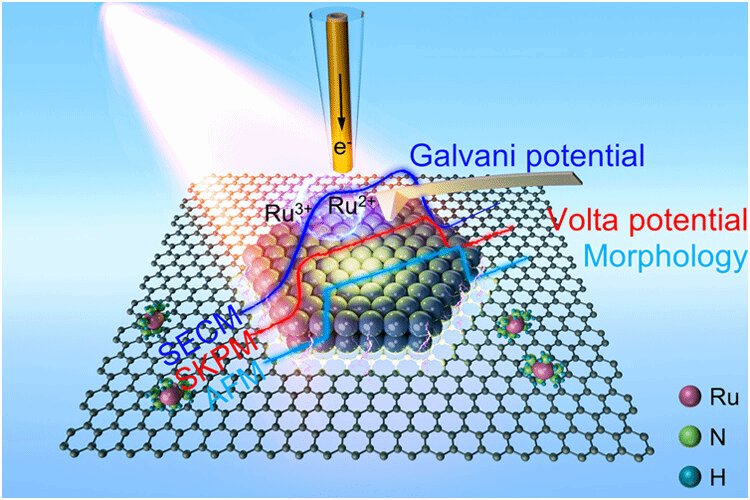
Abstract: Solar energy is the ultimate power source for mass and energy conversions on this planet through photochemical reactions. Among these, photoinduced interfacial electron transfer (PIET) reactions are driven by photofield-induced Volta potentials, fundamentally different from classical electrochemical processes by directly applied potential through a potentiostat. Herein, we develop a colocated scanning electrochemical microscopy (SECM) approach─integrating with atomic force microscopy (AFM) and scanning Kelvin probe microscopy (SKPM)─to correlate the morphology, Volta potential, and PIET kinetics at the same located silver sheet/single-layer graphene (Ag/SLG) electrode. We reveal that illumination induces π-π* transitions in SLG and d-electron excitations in Ag, leading to a synchronous positive shift of the Fermi level of the Ag/SLG electrode, acting effectively as a photogenerated interfacial potential. More importantly, the Volta potential difference across the Ag/SLG boundary, determined by their electron work function, remains nearly constant. The synergy between the photoinduced Volta potential and the Volta potential difference across the Ag/SLG boundary underpins the enhanced PIET efficiency. This study provides a direct methodology to quantify physical-field-driven interfacial electron transfer and establishes a framework for the rational design of catalyst/carrier systems beyond conventional electrochemical paradigms.
Full-Link: https://pubs.acs.org/doi/10.1021/jacs.5c19712
