Title: Decoupling the Cation-Induced Vibrational Responses at the Graphdiyne–Water Interface via In Situ Surface-Enhanced Raman Spectroscopy
Authors: Wang, Xiao-Ting; Wan, Jin-Long; Zhong, Han-Liang; Wang, Yao-Hui; Zhang, Xin-Yue; Peng, Zeyu; Hu, Ling-Yun; A, Yao-Lin; Cheng, Shimiao; Yang, Shuliang; Zhang, Hua; Yu, Jia; Li, Jian-Feng
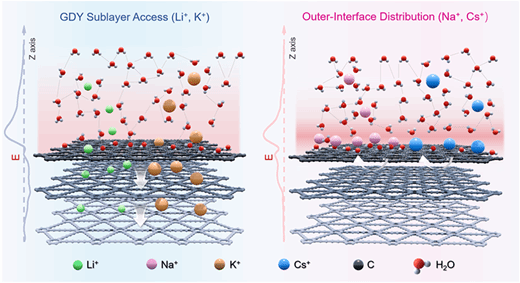
Abstract: Graphdiyne (GDY), featuring subnanometer pores and diacetylenic linkages, provides a platform for probing electrified carbon interfaces. Although the organization of cations and interfacial water governs electric double layer (EDL) structure and charge-transfer kinetics, tracking their reorganization and coupling with GDY remains challenging. Here, cation-dependent interfacial responses at Au–GDY electrodes were characterized using in situ surface-enhanced Raman spectroscopy and ab initio molecular dynamics (AIMD) simulations. A nonmonotonic cation dependence separates Li+/K+ from Na+/Cs+ rather than following a bare- or hydrated-ion size sequence. Under cathodic polarization, LiOH/KOH retain a single red-shifting diacetylenic band, while NaOH/CsOH develop an additional low-frequency band. This grouping coincides with distinct potential-dependent vibrational responses of cation-coordinated water and the GDY framework. AIMD indicates that Li+/K+ access GDY sublayer regions, whereas Na+/Cs+ remain mainly near the outer interface within the simulated time window. Combined analyses support a synergistic ion-sieving mechanism governed by hydration-shell reorganization, pore confinement, and cation–GDY interactions. This distribution is accompanied by interfacial-water reorganization and changes in local vibrational environments of the GDY framework. Together, these findings provide a molecular-level framework for understanding cation-specific EDL behavior at porous carbon interfaces, with implications for ion-selective electrochemical interfaces.
Full-Link: https://pubs.acs.org/jacsat/article/doi/10.1021/jacs.6c10062/5429482/Decoupling-the-Cation-Induced-Vibrational
