Title: Octahedral-coordinated Co3O4 for water electrolysis in acid
Authors: Wang, Yue; Ji, Yujin; Zhou, Jing; Chen, Jinxin; Li, Chenchen; Zhao, Chendi; Ke, Jia; Xiong, Yutian; Pan, Sihui; Huang, Wei-Hsiang; Pao, Chih-Wen; Kuo, Chang-Yang; Chen, Chien-Te; Li, Youyong; Hu, Zhiwei; Shao, Qi; Huang, Xiaoqing
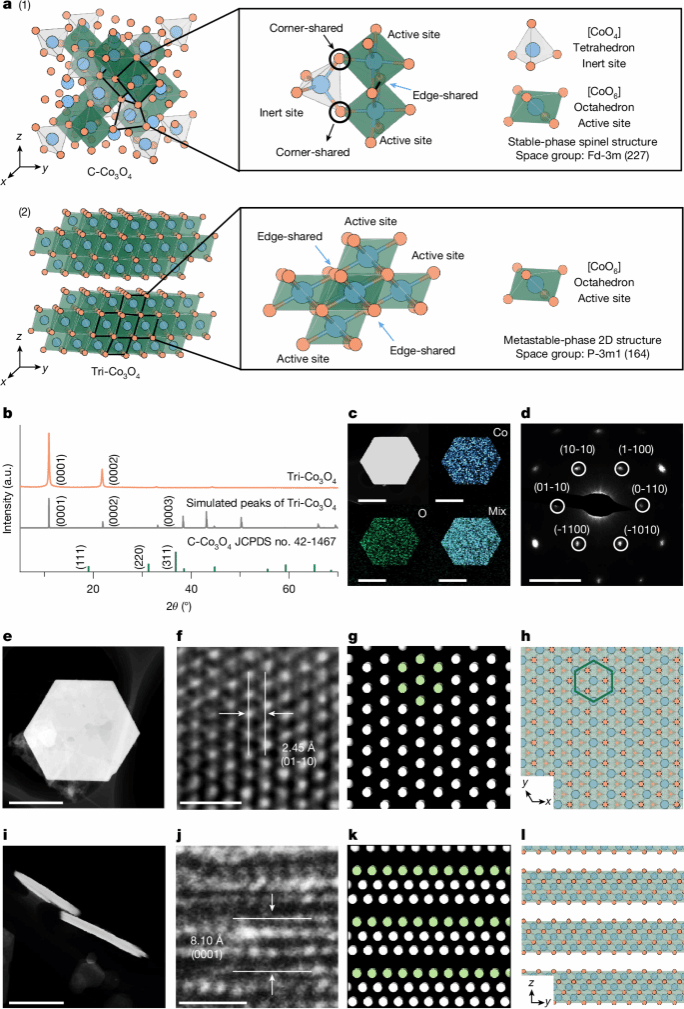
Abstract: The development of highly active and stable non-noble metal oxide catalysts to replace iridium-based materials for efficient acidic water electrolysis is crucial 1 , 2 , 3 . However, traditional spinel cobalt oxide suffers from intrinsic performance limitations from coexistence of inactive tetrahedral (T d ) and highly active octahedral (O h ) coordination sites 4 , 5 . Here we report a new trigonal-phase Co 3 O 4 (Tri-Co 3 O 4 ) produced by a vacuum-mediated molten-alkali mechanochemical method, which shows edge-shared [CoO 6 ] octahedral coordination with the space group P-3m1 (164). The three-layer compact structure provides Co 2+ and Co 3+ located in octahedral coordination in the ratio 1:2. Tri-Co 3 O 4 achieves a low overpotential of 269 millivolts (mV) at the current density of 10 mA cm −2 in the acidic oxygen evolution reaction (OER), 181 mV less than spinel-type Co 3 O 4 . It also achieves a current density exceeding 1,800 mA cm −2 at a cell voltage of 1.80 V in proton-exchange membrane water electrolysis (PEMWE) devices. The catalytic mechanism shows that the 2D layered structure with edge-shared octahedral coordination can effectively optimize the adsorption of intermediates and reduce the dissolution of Co, thereby substantially improving the activity and stability of the non-noble metal catalysts.
Full-Link: https://www.nature.com/articles/s41586-026-10851-7
