Title: Transforming spinel LiMn2O4 into a Na-layered cathode
Authors: Wu, Zixin; Chen, Diancheng; Lin, Ting; Yang, Maolin; Hu, Chunjing; Zhang, Dian; Chen, Leiyu; Tang, Yonglin; Liu, Qirui; Chen, Yilong; Yan, Yawen; Zhang, Kang; Kuai, Xiaoxiao; Wang, Qingsong; Xiao, Yinguo; Li, Chao; Sun, Yang; Liu, Xiang; Gu, Lin; Qiao, Yu; Sun, Shi-Gang
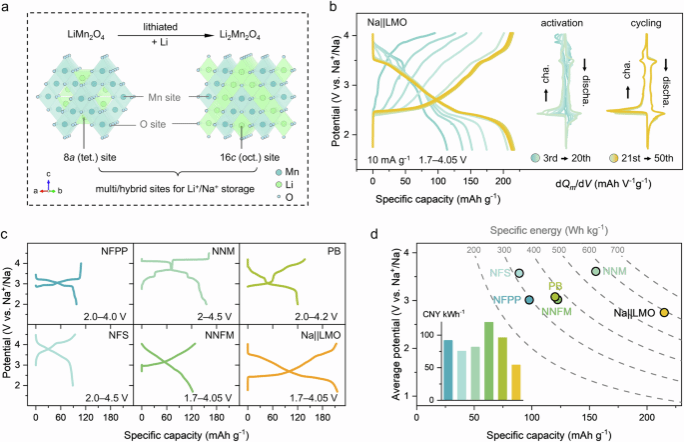
Abstract: The positive electrode structures of practical sodium-ion batteries are generally confined to polyanionic or layered transition metal oxide frameworks, where the trade-off between specific energy and structural stability limits their application. As a well-established positive electrode structure in lithium-ion batteries, the spinel framework has abundant storage sites for alkali metal ions, but it has received less attention for sodium-ion batteries. Here we show that spinel LiMn 2 O 4 can be transformed into a sodium-ion positive electrode. Electrochemical sodiation drives Mn-ion migration along an octahedral–tetrahedral–octahedral pathway, creating a layered/spinel heterostructure for further sodium storage. Moreover, residual spinel domains inhibit the strain and structural degradation within the layered structure. Consequently, a 26650 cylindrical cell using a LiMn 2 O 4 -derived sodium-ion positive electrode achieves a capacity of 3.85 Ah and retains 95.7% capacity after 900 cycles (1.925 A). This work demonstrates that spinel LiMn 2 O 4 can serve as a viable positive electrode for sodium-ion batteries, and that electrochemical transformation is a feasible approach for creating positive electrode frameworks.
Full-Link: https://www.nature.com/articles/s41467-026-79390-z
